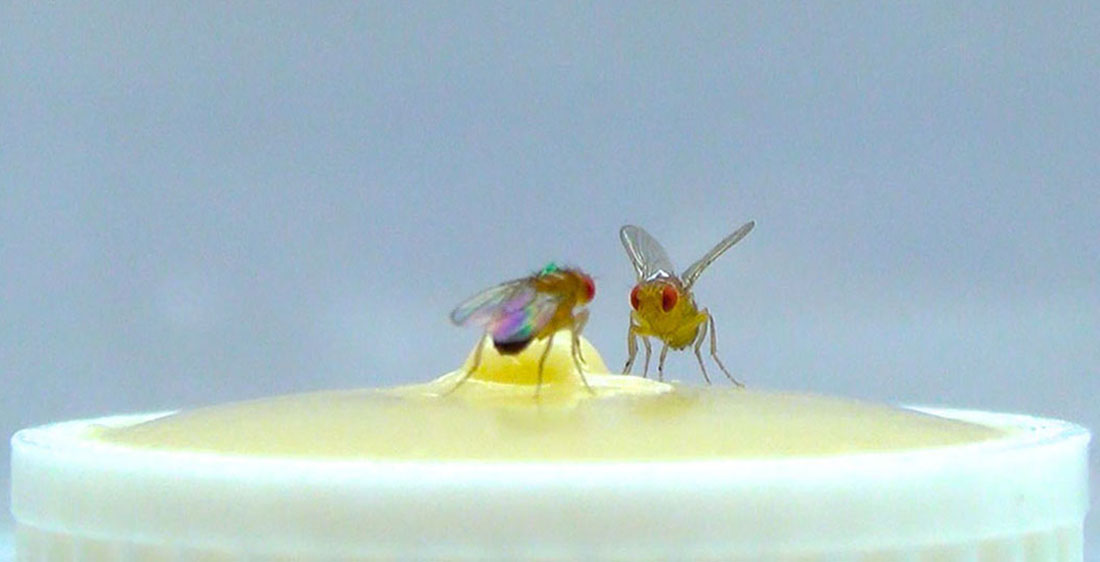
Aggression is a nearly universal feature of the behavior of social animals. In the wild, it is used for access to food and shelter, for protection from predation and for selection of mates, all of which are essential for survival. Despite its importance, little is known of the neural mechanisms that underlie aggression. Clues about these mechanisms come from studies highlighting the importance of hormonal substances in the behavior. In essentially all species of animals, including man, amines like serotonin have been implicated in aggression. Moreover, good evidence supports the notion that a multiplicity of hormones and neurohormones influence this complex behavior. Recent studies in both vertebrate and invertebrate systems suggest that neurohormonal systems interact with each other in complex ways to regulate, assemble and activate this behavior. With the genome fully sequenced, with elegant genetic tools available for the selective manipulation of genes in subsets of central nervous system neurons down to single neuron levels, and with a robust quantifiable behavior to examine, fruit flies offer a powerful experimental system with which to explore the fundamental mechanisms underlying this behavior.
Fruit flies and aggression
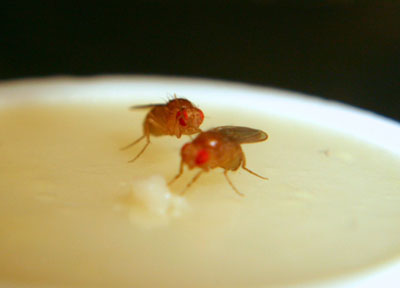
Quantitative assessment of aggression in normal male and female flies is an essential step before we try to determine the consequences of altering genes in mutant animals. Towards that goal we defined the behavioral patterns seen during fights (constructed an ethogram), generated transition matrices of the patterns and performed a first order Markov analysis of the data. The Fly model is a good fit for such ethological analysis of data, and our analysis showed that some fighting patterns seen were male selective, some female selective and some were shared. Among the male patterns, the lunge (one fly rises to a 90 ° angle and strikes down on the opponent with great force with the forelegs) proved to be the most important in determining the outcome of a fight. Males established hierarchical relationships during fights, females did not. Observing these sexual dimorphisms suggested that genes of the sex-determination cascade might be involved in the behavioral differences. Collaborative studies with Eleftheria Vrontou from the Dickson laboratory demonstrated that, as in courtship behavior, the fruitless gene of the sex determination cascade was involved.
Amines and Aggression
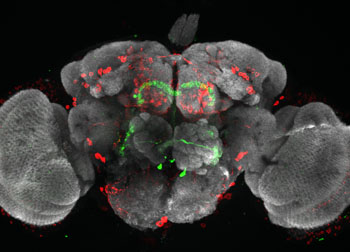
There are about 100 each of serotonergic and octopaminergic neurons in the fly brain and about several hundred dopaminergic neurons. Experimental genetic manipulation of entire populations of amine neurons, leads to displays of multiple phenotypes in progeny. Thus serotonin neurons are found to be involved in the frequency of going to higher level aggression in fights, but also influence movement, and alter feeding and courtship behaviors. Octopamine neurons are involved in the decision-making made by male flies between courtship and aggression in the presence of a conspecific. They also are involved in the intensity of fighting, egg-laying, learning and memory, etc. To sort out the multiple phenotypes, and to address the question of the role or roles served by single amine neurons in influencing behavior, we utilized an intersectional genetics strategy. In this method we combine the Gal4 method with the flp-recombinase technique. We have generated 200 enhancer trap lines in which the flp recombinase enzyme is synthesized in different sub-groups of central nervous system neurons. When these lines are combined with amine specific Gal4 lines and a UAS>stop>desired protein line, only in neurons where both the amine and the recombinase enzyme are made will the < stop < codon be removed by the recombinase allowing the protein (or RNA) products to be expressed. Thus far about 20-30 single amine neuron pairs have been isolated in this way and these have been demonstrated to be functionally alterable using this technique. Male flies will fight with or without serotonin, but with serotonin they fight at much higher intensity levels. Using the intersectional strategy, we found a single pair of serotonergic neurons that, when their function is altered with tetanus toxin, duplicate the aggression phenotype seen when all serotonin is depleted from the nervous system. These neurons are highly selective for aggression, having only small effects on other behaviors. We also have found two pairs of dopaminergic neurons that appear to have opposite behavioral effects. At present we are exploring the pre- and post-synaptic circuitry surrounding these neurons in efforts to elaborate the circuitry concerned with the higher intensity fighting behavior displayed by male flies during fights.
Learning and memory during fights, the “loser” mentality and “bullies”
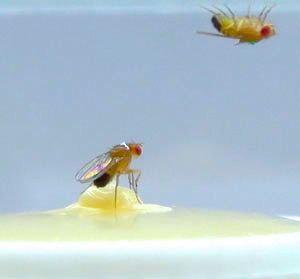
Fights between male flies usually end in the establishment of hierarchical relationships. There is a dynamic during fights in which flies alter their strategies as the fight progresses in what appears to be an operant learning situation. The first fly that lunges, if the opponent runs away, is 16 times more like to be the ultimate winner. Short term winner and loser effects can be demonstrated in which winners are more likely to win their next fights, losers more likely to lose. With a “spaced” training protocol in which losing flies fight and lose a number of short fights in a row, the loser effects can be extended to at least 24 hours, which is not seen with winners. Using classical mutant lines combined with modern genetic methods involving the use of various binary systems (Gal4, LexA, Q system) and the intersectional genetic strategy, we are beginning to unravel the learning and memory circuitry and explore how it interfaces with the aggression-related circuitry in the fly brain.
By inbreeding winners of male-male fights for 35 generations, we have generated a hyper-aggressive line of flies that we call “bullies”. These flies go to higher intensity levels faster, always retaliate when lunged at, and display high numbers of lunges and boxing (very rare in the parent strain) behavior during fights. They always win fights against the parent Canton-S strain. We are taking a genomic and developmental approach to explore the differences between bully flies and the parent strain, and thus far have identified a number of key genes that show important differences in levels of expression in the bullies.