|
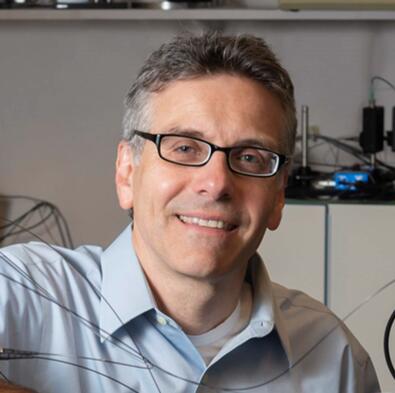
Bernardo Sabatini, M.D., Ph.D.
Assistant Professor of Neurobiology
Harvard Medical School
Department of Neurobiology
220 Longwood Ave
Boston, MA 02115
Telephone: 617 432-5670
Fax:617-734-7557
Email: bernardo_sabatini@hms.harvard.edu
Predocs: 2 Postdocs: 7 Completed PhD's: 3
|
 |
The goals for my laboratory are to uncover mechanisms of synapse regulation in the mammalian brain and to understand how perturbations of synaptic transmission contribute to neurological diseases. Our studies utilize technology we developed to examine the biophysical, structural, and functional properties of individual synapses and dendritic spines. This is accomplished using novel microscopes that allow us to directly stimulate individual postsynaptic terminals while monitoring evoked electrical and biochemical signals. In addition, we design experiments in which cell-autonomous effects of signaling pathways are isolated and in which pre and postsynaptic effects of perturbations are clearly separated. Our research has revealed a rich set of regulatory mechanisms and cellular specializations that allow each synapse to independently control the biochemical and electrical consequences of its stimulation. Furthermore, by applying the same quantitative and rigorous analysis of synaptic transmission to the study of rodent models of human disease, we have uncovered synaptic perturbations that likely contribute to the pathogenesis of Tuberous Sclerosis Complex (TSC), an Autism Spectrum Disorder, and Alzheimer’s Disease (AD), a common late-onset form of dementia.
|
References:
- Bloodgood, B.L. and Sabatini, B.L. (2007) Nonlinear regulation of unitary synaptic signals by CaV2.3 voltage-sensitive calcium channels located in dendritic spines. Neuron 53:249-60.
- Shankar, G.M., Bloodgood, B.L., Townsend, M., Walsh, D.M., Selkoe, D.J. and Sabatini, B.L. (2007) Natural oligomers of the Alzheimer amyloid β-protein induce reversible synapse loss by modulating an NMDAR-dependent signaling pathway. J. Neurosci, 27(11):2866-75.
- Alvarez V.A., Ridenour D.A. and Sabatini B.L. (2007) Distinct Structural and Ionotropic Roles of NMDA Receptors in Controlling Spine and Synapse Stability, J. Neurosci, 27(28):7365-76.
- Carter A.G., Soler-Llavina G.J. and Sabatini B.L. (2007) Timing and Location of Synaptic Inputs Determine Modes of Subthreshold Integration in Striatal Medium Spiny Neurons. J. Neurosci, 27(33):8967-77.
- Xu W., Schlüter O.M., Steiner P., Czervionke B.L., Sabatini B.L., and Malenka R.C. (2008) Molecular dissociation of the role of PSD-95 in regulating synaptic strength and LTD. Neuron, 57(2):248
- Busetto G., Higley M.J., and Sabatini B.L., (2008) Developmental presence and disappearance of postsynaptically silent synapses on dendritic spines of rat layer 2/3 pyramidal neurons. J. Physiol. 586(6):1519-27
- Shankar GM, Li S, Mehta TH, Garcia-Munoz A, Shepardson NE, Smith I, Brett FM, Farrell MA, Rowan MJ, Lemere CA, Regan CM, Walsh DM, Sabatini BL, Selkoe DJ. (2008) Amyloid-beta protein dimers isolated directly from Alzheimer's brains impair synaptic plasticity and memory. Nature Medicine, 14(8):837
- Steiner P, Higley MJ, Xu W, Czervionke BL, Malenka RC, and Sabatini BL (2008) Destabilization of the postsynaptic density byPSD-95 serine 73 phosphorylation inhibits spine growth and synaptic plasticity. Neuron, 60:788-802
|
|