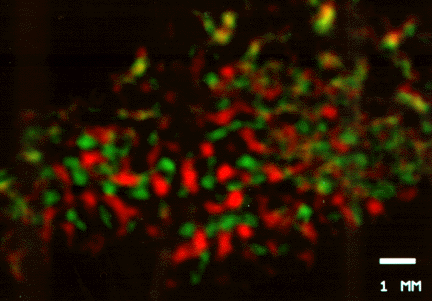
Direction map in macaque area MT demonstrated with a double-label 2-deoxyglucose (2dg) technique (Tootell, Born & Hamilton 1988). An anesthetized, paralyzed macaque monkey viewed a large field (~60 deg.) of random dots that moved coherently in one of two directions. In the first half of the experiment the dots moved downwards while 14C-labelled 2dg was infused intravenously. After 45 minutes of this condition, the direction of dot motion was reversed (to upwards) and 3H-labelled 2dg was infused. The two labels were discriminated based on the differential path lengths of the beta particles emitted by the two isotopes. In this section, cut parallel to the cortical surface, the direction columns are shown in cross section with red representing clusters of neurons responding optimally to downward motion and green representing those repsponding optimally to upward motion. The opposite directions of motion produced label in interdigitating columns consistent with the physiological studies of Albright et al. (1984).